Normalised connectivity
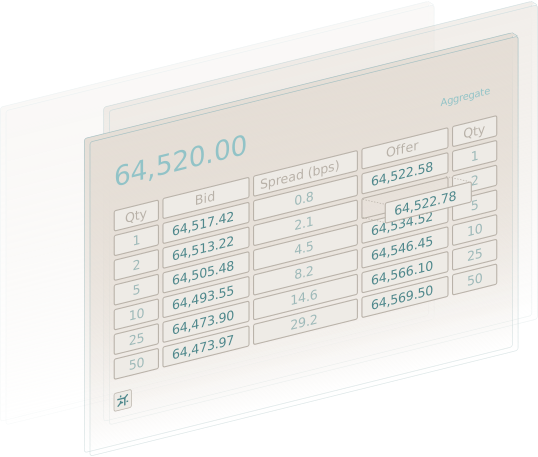
Connect direct and third-party liquidity through one interface and API instead of maintaining provider-specific workflows throughout your stack.

[ Stelaxis Edge / Institutional orchestration ]
Edge connects the liquidity, custody and internal systems you already use. Standardise how trades are priced, controlled, settled and reconciled—without making a new provider the centre of your business.
[ When the stack becomes the constraint ]
[ The Edge proposition ]
Edge sits above provider relationships and below your client experience. It gives each team a consistent workflow while preserving the freedom to choose where you trade, hold assets and settle.
Connect direct and third-party liquidity through one interface and API instead of maintaining provider-specific workflows throughout your stack.
Bring price discovery, orders, permissions and desk limits into the same path before activity reaches the market.
Carry the account, portfolio and counterparty context from execution into settlement, balances and positions.
Reconcile activity against a shared record so exceptions surface without teams rebuilding the day by hand.
[ Edge Intelligence ]
Edge Intelligence connects market, execution and post-trade activity into one explainable operating view. Ask questions in plain language, surface exceptions before they become incidents and prepare approved workflows without handing control to a black box.
Explain routing, fills, slippage and market impact using the context behind each decision.
Detect settlement, balance and reconciliation exceptions across providers and accounts.
Connect incidents, decisions and runbooks so knowledge remains available beyond one person or shift.
Prepare and execute permitted actions through defined limits, approvals and a complete audit trail.
[ Governed by design ]
AI can explain, recommend and prepare an action. Edge remains the system that applies permissions, limits and approvals—and records what happened.
[ A reason to change ]
01 / Add a relationship
New liquidity or custody relationships plug into the operating layer instead of creating another parallel process for every team.
02 / Control activity
Permissions, limits and trading context are applied consistently, whether users work through the interface or your own systems.
03 / Close the loop
Executions arrive in settlement and reconciliation with the context operations needs to act, investigate and report.
[ Where Edge earns its place ]
Compare and execute across the relationships available to your institution without rebuilding the trader workflow around each one.
Power a client proposition while retaining control of counterparties, pricing logic, permissions and the customer experience.
Coordinate settlement and reconcile activity across counterparties and custodians from a shared operational view.
Retire manual handoffs and overlapping point tools one workflow at a time instead of committing to a big-bang replacement.
[ A practical adoption path ]
Edge can sit alongside the systems already in production. Start where fragmentation is most expensive, measure the result, and extend the same control layer only when it earns the next workflow.
[ Built for institutions already in motion ]
Operate institutional or client-facing digital asset products without hard-wiring the business to one liquidity or custody provider.
Give execution and operations one path across market access, controls, positions and settlement activity.
Embed institutional trading workflows through APIs while preserving your own product, relationships and client experience.
[ Start with the stack you have ]
We will map where Edge fits, what stays in place and what a useful first deployment would need to prove.